

 LinkedIn
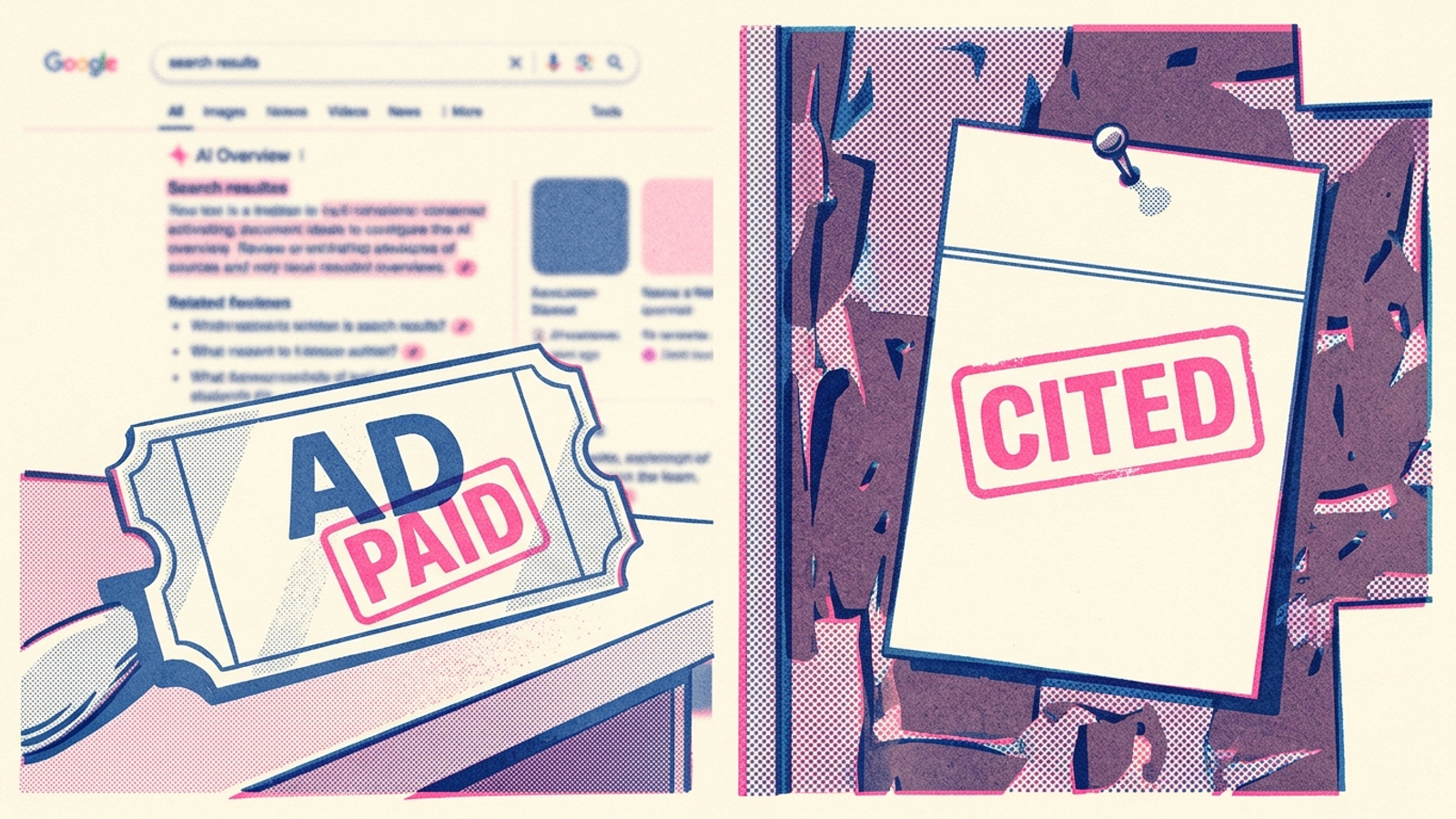
The ad in an AI answer is not the citation. I spent years buying the paid side, and I still hear the assumption from business owners searching “ai overview ads”: pay for the placement, get named as a source. That mistake sends money to the wrong line item. The other six myths are variations on it.
Myth 1: “If I buy the ad in the AI answer, Google will cite me too”
People believe this because the ad and the answer can appear together. Your name is on the screen, so it feels as though you paid for inclusion in the answer itself. I had clients ask the obvious question: if we are paying, why are we not listed as a source?
Because the ad slot and the citation use separate systems. The ad depends on an auction: bid, budget, Ad Rank and eligibility. The citation depends on retrieval: which passage answers the question Google is trying to address. In an SE Ranking analysis of commercial AI Mode queries, a text ad appeared on 29% of keywords, but the advertiser domain appeared among cited sources only 11% of the time; the exact URL appeared 1.95% of the time. Same screen. Different job.
You can tell them apart without a decoder ring. If it says Sponsored, you rented the placement. If your page appears as a linked source under the answer, you earned a citation. Budget for the ad if you want the paid click today. Do not log it as citation progress, and do not cut an ad that earns sales because it fails to buy something ads cannot buy.
Myth 2: “Rank #1 and the AI Overview has to cite you”
I used to tell clients this by implication. Get to position one and everything else follows: clicks, trust, now AI mentions. I was wrong. A rank gives your page a chance to be considered; it does not make every passage on that page the best answer.
Ahrefs looked at 863k SERPs in January 2026 and found that 37.9% of AI Overview citations ranked in the top 10, 31.2% ranked from 11 to 100, and 31.0% fell outside the top 100. A stricter BrightEdge overlap check put the top-10 match around 17%. Those are different checks, but neither supports the idea that position one reserves a source card.
The mechanism is query fan-out. Google can break one broad question into sub-searches about cost, timeline, risks and alternatives, then pull passages that address those parts. iPullRank connects that process to the drop from an older 76% overlap figure to Ahrefs’ 37.9%. Your page can win the head term and still leave the cost question to a page at position 14 that answers it plainly.
If you rank but rarely get cited, inspect the page before commissioning another post. Look at the question the answer addresses. Does your page give a usable answer near the top, or does it make a reader wade through a brochure? Start with a page already at position 8, and make one passage answer one buyer question in the first 100 words. Ranking gets you into the candidate pile. The passage still has to do its work.
Myth 3: “ChatGPT, Perplexity and AI Overviews all cite the same sources”
People say “AI search” as if it were one distribution channel. They publish one listicle, wait for three engines to pick it up, then wonder why the results differ. Each engine retrieves material through its own path before it writes an answer. A source that fits one path need not turn up in another.
Across 1,429 answers to 88 questions, LinkedIn earned 246 citations in Perplexity against 6 in ChatGPT, while YouTube earned 214 in AI Overviews against 4 in ChatGPT. The differences ran down to individual domains: one contractor domain drew 46 ChatGPT citations and none in AI Overviews, while google.com appeared 310 times exclusively in AI Overviews. One study does not give you a permanent recipe for every engine. It does give you a good reason not to combine them into a single visibility score.
Measure each engine separately. Pick the one your buyers use, check which kinds of sources it cites for your questions, and put effort there. A higher Google rank is not, by itself, a Perplexity plan. If you want the retrieval mechanics, read how ChatGPT and Perplexity pick sources. The practical point is smaller: do not buy or publish for a blended metric that hides where you are absent.
Myth 4: “Once you’re in, you stay in”
Blue links can feel sticky. Hold a ranking for six months and it is tempting to assume a citation will hold too. I learned to distrust that assumption with landing pages: a client would change one without telling me, Quality Score would fall, CPCs would rise, and the account would look inexplicably worse until we checked the page. The page behind the performance matters after launch.
AI citations move as well. One analysis reports 40–60% of cited domains changing month to month and 70–90% rotating out over six months; it also finds AI Overview results more volatile than organic results. That does not mean any given citation expires on day 30. It means a citation is not a trophy you put on a slide and forget.
There is a reason to watch it. The same analysis associates AI Overview citations with 35% more organic clicks and 91% more paid clicks than non-cited competitors, even as paid and organic click-through rates on those queries fell. Association is not a promise that a citation will produce either lift for your business. It is enough to make disappearing from an important answer worth noticing.
Recheck your money prompts monthly. If a passage that used to appear has gone missing, look at the answer, the competing passages and your page before ordering a rewrite. Refresh what is stale; do not replace a useful answer just because a calendar reminder fired.
Myth 5: “Publish more and the citations will follow”
This is the content-farm hangover. Teams used to make ten pages for ten keyword variations, so ten possible citations sounds like a sensible target. But another near-duplicate page does not supply a new answer. It can make the useful page harder to identify.
AI systems select for content that is authoritative, reliable, relevant, complete and clear; adding pages does not automatically add citations or visibility. I have seen the paid-search version of this mistake. Ten ad groups chasing the same intent do not magically give you ten times the traffic. They give you more places to look while you try to work out what happened.
Make one useful page earn its space before making ten more. Cut overlapping pages where they repeat each other. Give the survivor a direct answer up top, a price or timeline where it matters, and headings that say what each passage covers. A reader should be able to find the answer without decoding your taxonomy. So should a retriever.
Myth 6: “My niche is too boring for AI answers”
I hear this from home services, B2B parts suppliers and local trades. “Nobody asks ChatGPT about garage doors.” Maybe not in those words. Buyers ask what a job costs, how long it takes and who does it near them. Those are questions a business can answer more concretely than a generic article can.
AI answer coverage began largely with informational queries, while commercial coverage grew through 2025. That does not mean every local service query gets an AI Overview, or that being niche guarantees a citation. It means “we sell something boring” is not a reason to ignore the answers your buyers already seek.
Use the questions you hear from buyers as page topics. If you serve three zip codes and handle several job types, make the relevant service details easy to find: what the job involves, the price or timeline when you can state one, and the exceptions a buyer needs to know. Check whether AI answers appear for those questions before you spend months on a campaign. Boring is fine. Vague is expensive.
Myth 7: “You can’t measure any of this, so don’t bother”
This is the hardest one to kill because it poses as sophistication. Smart people tell me attribution is broken, AI answers take the click, referral data is messy, so tracking citations is pointless. I get the frustration. I spent years stitching Search Terms to CRM stages for a SaaS client whose definitions kept changing. Measurement was never clean. It was still useful.
You do not need a perfect path from source card to closed sale to learn whether your work is gaining ground. You need a small, repeatable set of observations. Track these four numbers the same way each week:
- Citation frequency across 20 buying questions you care about.
- Brand mentions, with and without a link.
- Share of voice against two competitors on those same questions.
- Referral sessions from AI assistants in analytics.
Keep the prompts fixed long enough to see a pattern. If you change the questions, the pages and the reporting window at once, even a good result tells you very little. Compare before and after each page refresh. If citations move from 3 in 20 to 9 in 20 and referrals rise over the next two weeks, that is a signal worth investigating, not proof that the page alone caused every visit. A refresh test using rankings, citation rate, mentions, share of voice and AI referrals gives a small team a way to assess progress without enterprise software.
The work behind the scorecard has an order. Most teams start by publishing and remember measurement later. I would reverse it:
- Pick 20 money prompts and record the current sources. Use buying questions about cost, timeline, location or comparisons, not just broad head terms. Check which ones actually produce an AI answer.
- Fix a relevant page you already have. Put a direct answer in the first 100 words. Add real numbers where you have them and use plain HTML headings so each part is easy to identify.
- Keep the answer current and consistent. Check that the service name, price and service area on the page agree with the profiles you maintain elsewhere.
- Look for a corroborating mention off-site. A supplier page, local list or relevant thread can give a claim another place to appear. Choose the place based on the engine and question you are tracking, not on a generic “AI visibility” checklist.
That is also how I would settle the budget argument. Say you spend $20k a month on search and a strong service page sits at position 9 with no citations. Ten new articles are not the first move. Check the answer, improve the passage and watch the result. If paid search brings in sales now, keep it running. It buys a click, not a citation. Skip paid if you cannot handle the work it brings in: paused fulfillment, no tracking, nobody answering the phone. Otherwise, manage the paid and earned work from one scorecard rather than asking one line item to do both jobs. That is the logic behind groas running both sides as one program.
Start with a spreadsheet if that is what your team will open. When manual checks stop being manageable, choose a visibility tool by what it actually tracks: prompts and cited URLs, not just a vanity score. On Monday morning, open the answer to your best buying question and read the cited passages. Did they give the price, timeline or exception your page skipped? Write that down. Check again after you fix it.
I understand why “you can’t measure it” survives. It saves everyone the trouble of finding out whether the new pages helped. Imperfect measurement is still better than an untested claim on a slide.