

 LinkedIn
An llms.txt file is not an AI Overview strategy. Yet an agency can put one in your site’s root directory, call it an AI Search Readiness Package, and charge four figures for a deliverable it can draft in minutes.
The AEO market has rebuilt the worst commercial habit of 2015 SEO: selling cheap, symbolic rituals to buyers who know the platform has changed but have not been told how the work gets done. Back then, the invoice might cover sitemap submissions, meta keywords and a PDF of rankings. Now it covers a schema plugin, a Markdown file and a dashboard that counts how often an AI tool mentions your brand.
Counting a citation is not earning one. Vendors can monitor results far more cheaply than they can fix pages, so monitoring gets packaged as progress. The result is a business paying to watch a problem it still has to solve itself. I have spent enough time in search accounts to recognise that arrangement. It was annoying when the report tracked blue links. A new acronym has not improved it.
Ritual 1: The llms.txt file that comes with a strategy-sized bill
Jeremy Howard proposed the llms.txt convention in late 2024 as a clean, Markdown-formatted directory to help developer tools ingest documentation without hauling in CSS and navigation menus. That is a narrower job than the one AEO sellers gave it. Their pitch goes like this: upload a condensed account of your site, and Google’s AI models will read it, treat it as ground truth and quote you in AI Overviews.
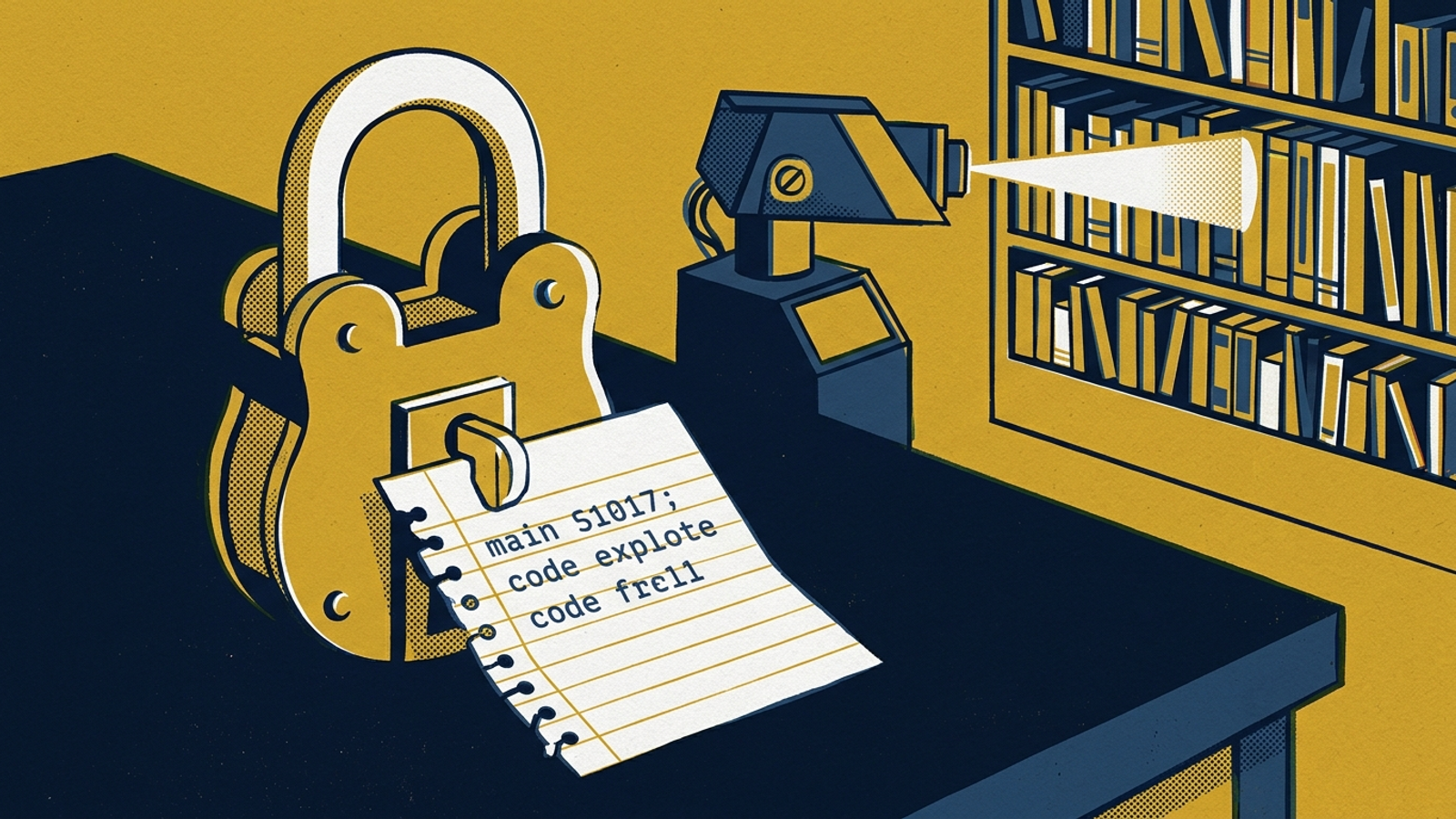
Google Search Central’s generative search documentation says site owners do not need machine-readable files, AI text files or Markdown directories to appear in AI Overviews or AI Mode. An Ahrefs study tracking 137,000 websites found that 97% of published llms.txt files received zero crawler visits. Neither point makes a text file inherently bad. It does make the file-as-citation-strategy pitch hard to defend.
So why does it appear on an invoice? It is quick to draft, simple to upload and requires none of the awkward work inside the actual pages. An agency can turn a homepage into a Markdown summary, mark the milestone complete and leave the pricing page that buries its prices untouched. When citations do not follow, there is always another month to bill.
If the proposed work begins and ends with a text file, keep your money for the pages people and search systems can actually read.
Ritual 2: Schema markup sold as a citation switch
The second ritual is structured data theater. An agency rebrands a basic schema audit as an AEO indexing framework, then tells you that nesting enough AboutPage, ItemAvailability and TechArticle JSON-LD will turn your URLs into primary citations for Gemini. Machines parse code. Schema is code. The slide practically writes itself.
The citation evidence is less obliging. Ahrefs tracked 1,885 pages that added JSON-LD schema between August 2025 and March 2026 alongside 4,000 control pages. The pages with new schema saw a 4.6% decline in AI Overview citations; movements in AI Mode (+2.4%) and ChatGPT (+2.2%) were statistically insignificant. That does not mean schema caused the decline. It means the study did not show the citation lift being sold.
Schema has ordinary search uses, including helping parsers identify information for standard search features. It is not a substitute for an answer on the page. If your service page hides pricing, process steps and specifications beneath three screens of brand language, a pristine block of JSON-LD will not make the prose useful. The reader still has to find the answer. So does a system selecting passages to cite.
Paying to configure a plugin while leaving vague copy untouched is polishing the hubcaps on a car with no engine. Keep the markup that serves a purpose. Spend the effort where the missing facts are.
Ritual 3: A dashboard that watches the problem
If you want to see how software monetises panic, look at an AEO tracker’s pricing page. Many of these tools query an AI system, count appearances of your brand and display the count in a chart. That can tell you something useful. It cannot edit a page, test a better answer or deploy a correction.
The pricing makes the distinction worth asking about. Squirrelscan’s market review of GEO tools lists Otterly.ai at $29 a month for 15 tracked prompts, Profound at $99 to $399 a month for 50 to 100 prompts, and AthenaHQ starting at $295 a month. These are prices for products with their own features, not a reliable calculation of each vendor’s cost per query. But the purchasing question is simple: what changes after the chart shows a loss?
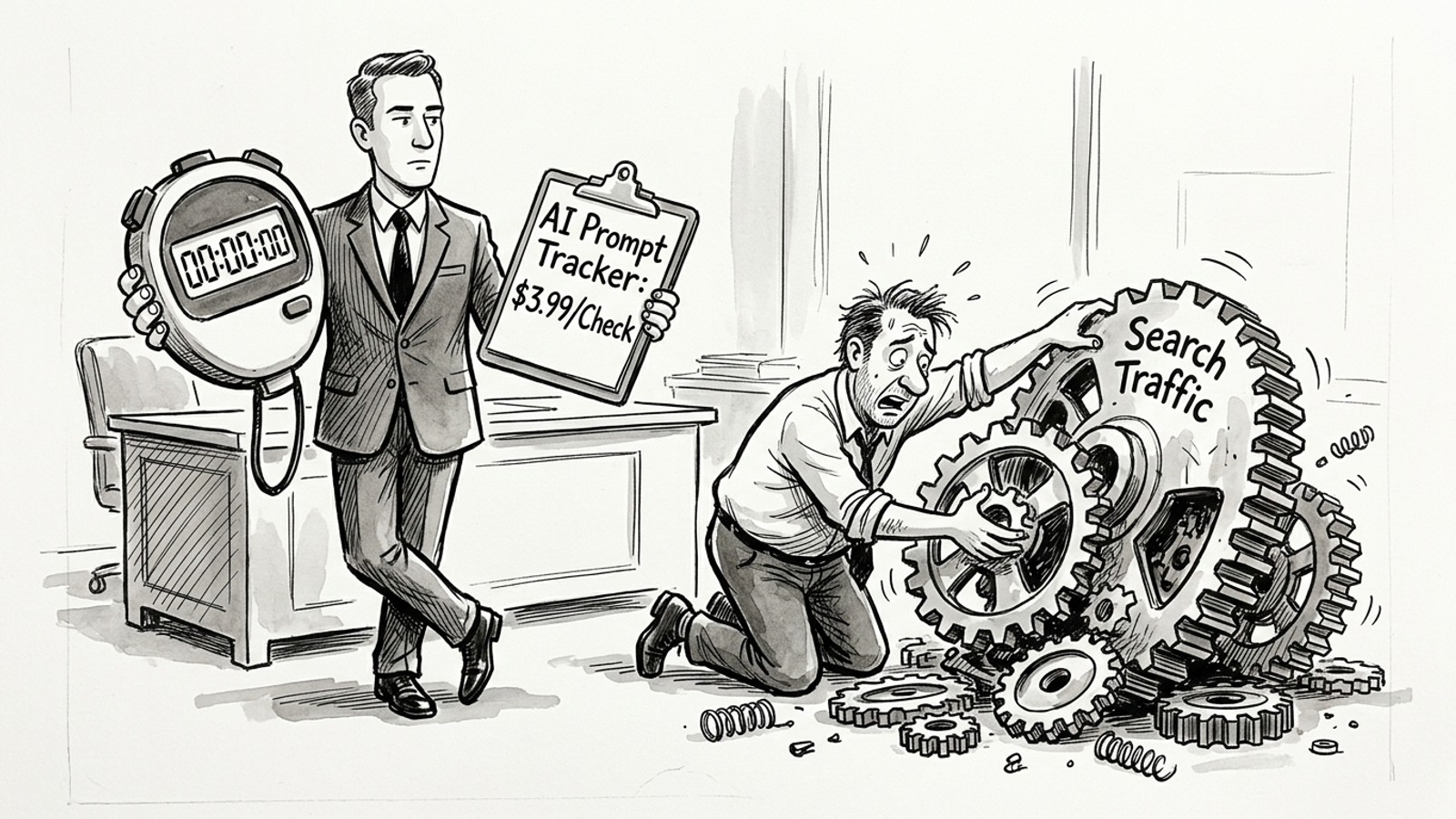
People searching for tools to get featured in Google AI Overviews usually want the visibility gap closed. Instead, a monitoring-only product can tell them when a competitor gets cited. It can tell them again tomorrow. An alert that your share of voice fell 14% is useful only if someone can inspect the relevant pages, improve the passages that fail to answer the query, publish the changes and check what happens next.
Otherwise, you have bought an anxiety subscription. Ask who does the work before you pay for the warning.
Ritual 4: The GEO deck that leaves the pages alone
The fourth ritual arrives as a strategy deck: forty slides of familiar keyword research wearing a new badge. An agency renames target keywords conversational prompt matrices, draws a Venn diagram of semantic intent and charges $8,000 to explain that customers ask questions before they buy. The recommended topics look suspiciously like the content plan you already have.
The underlying promise is often that traditional ranking success will take care of AI citations: win position one in blue links, and the Overview will follow. The relationship is not that tidy. A Conductor analysis of nearly 168 million AI Overview citations found that 57% of cited pages sat outside the organic top 10. In that study, a page holding position one earned an AI Overview citation 25% of the time. Ahrefs also found that 37.9% of cited URLs ranked in Google’s organic top 10 in its analysis of 863,000 search result pages, down from 76% in mid-2024.
A ranking report cannot stand in for a citation plan. The overlap matters, but it does not justify handing a team another deck that says create comprehensive pillar content and calling the job done. Look at the pages you already own. Where is the answer? Can someone extract it without interpreting three paragraphs of positioning copy? Are the facts on that page current?
If the audit stops before a page changes, you bought a description of the work.
What earns citations is less glamorous
Put the answer where it can be found
Generative search uses retrieval to find relevant material before assembling an answer. That makes a page’s usable passages more important than its ability to sound impressive in an introduction. In a RankSense AI study of 55,000 queries, original proprietary research appeared with a 38% to 65% citation rate, compared with 6% to 15% for derivative articles. Pages refreshed within the previous 90 days were roughly three times more likely to be cited in synthesised answers. Those findings are not a recipe or a guarantee. They are a reason to examine what the page actually gives a reader.
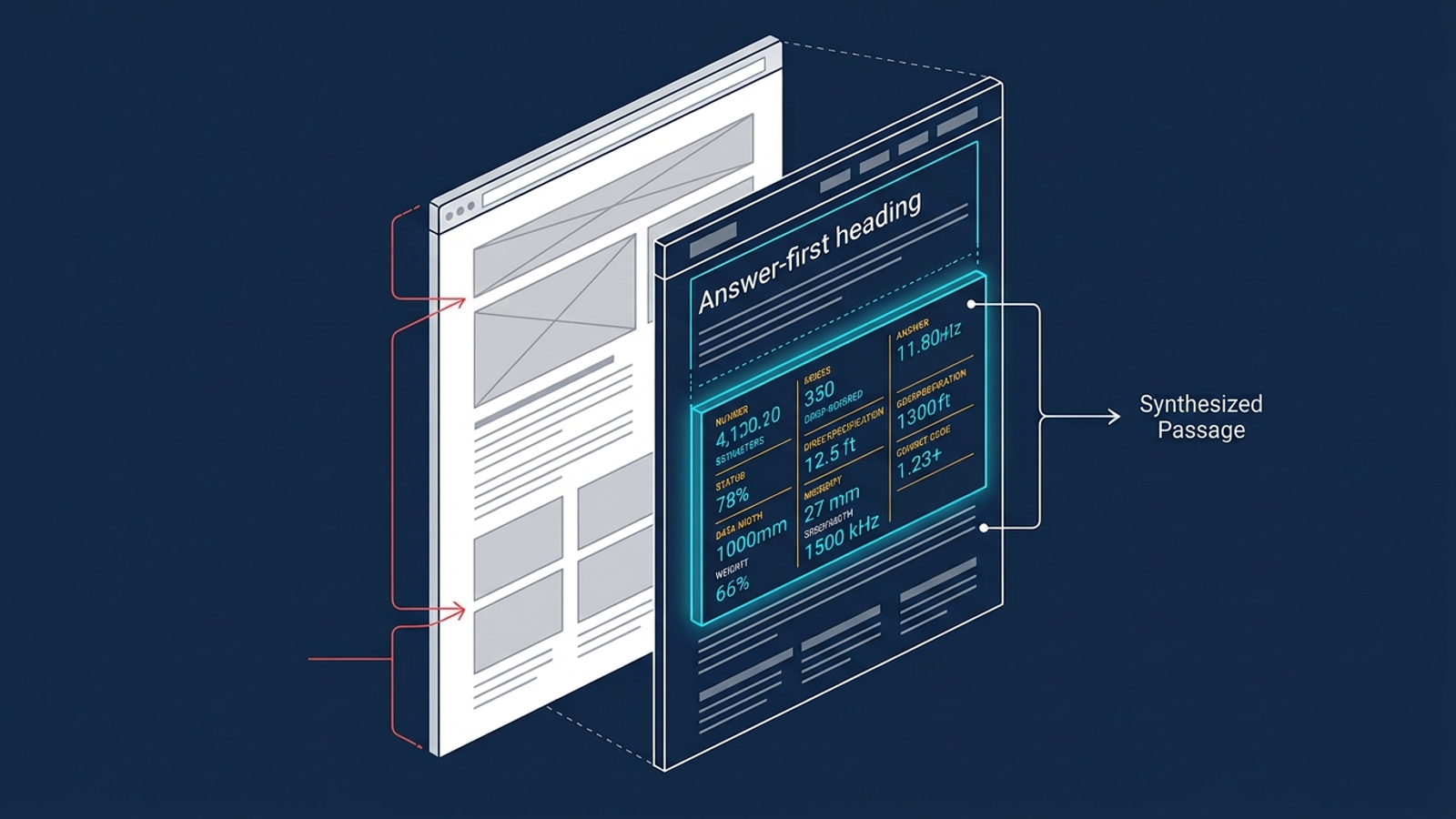
I would start with a page that already has some search visibility, not commission another 4,000-word preamble. Fix the page already at position 8: move the definition, cost calculation or process steps beneath the heading that promises them. Use a clear HTML table when numbers need comparing. Remove the introduction that explains why the topic is important to an audience that has already searched for it.
Make the answer easy to extract because you have made it easy to read. That is useful even when a particular page does not win a citation.
Check what other sites say, then keep your pages current
Your own site is not the only place a claim can be checked. If a page says your software integrates with twenty enterprise platforms, but partner directories and other relevant sites say nothing about those integrations, you have a claim with little external support. Check the facts on your pages against the places a buyer might also look. Correct stale information. Pursue relevant off-site mentions rather than assuming your own copy settles the matter.
Then keep doing it. A one-time audit cannot keep pace with pages whose facts change or with the questions people ask about them. Citation work needs an owner after the audit ends. Otherwise even a good recommendation becomes another ticket waiting behind a product release.
Close the gap between the report and the edit
This is the part the AEO market prefers to split into separate invoices. An agency identifies a problem. A dashboard confirms it is still there. Your developers and writers inherit the fix list while the invoices continue. I do not object to diagnosis; I object to selling diagnosis as though it were execution.
groas takes the better side of that split: a fully autonomous growth engine that acts on search work rather than merely reporting it. It rewrites content for answer extraction, restructures page hierarchies, and manages bids and targeting continuously, with a named human strategist setting guardrails. Actions are logged with their operational reasoning. That is a stronger alternative to paying a monitoring vendor to tell you what your own team must still change.
The distinction is not human versus machine. It is an accountable change versus another observation. Ask for the former.
Five questions before you pay an AEO vendor
Before you sign a retainer or enter a credit card, run the offer through this filter. The answers should tell you whether the vendor owns any part of the work after it identifies the problem.
- Does it change anything on my site, or only observe it? A visibility report leaves the edits with your team.
- Can it show what it changed? Ask for a record of page or campaign adjustments and the reasoning behind them.
- Is pricing tied to work done or prompts watched? Know which one you are buying.
- What happens when a citation drops? An email alert is a notification, not a fix.
- Who owns the fix list: me or them? If it is you, budget for the writers and developers as well as the vendor.
That fifth question is the one most likely to expose the real price. A forty-item spreadsheet of recommended rewrites may look like a finished engagement. If every item then lands on your payroll, the vendor has charged you to assign homework. The cost is not just the retainer; it is the work still waiting to happen.
Stop paying for symbolic rituals. A text file, a plugin, a deck and a prompt chart can each have a use, but none deserves to be sold as the act of earning citations. Pay for the answer on the page, the facts that support it and the person or system responsible for getting the fix live.
Watching yourself lose is not a growth strategy.